The complete Iran conflict holiday guide
Safety, rights, costs and destinations — everything UK travellers need in one place.
Millions of people are pivoting from the Gulf to Spain and Greece. Here's where to go instead — destinations that are genuinely outstanding, completely unaffected by the conflict, and not about to be swamped by the crowd doing the obvious thing.
Short on time? Let us summarise this guide for you.
Millions of people who were planning Gulf or long-haul holidays are now pivoting to Spain, Greece, Portugal and Turkey. Those are all excellent choices — but the flood of displaced travellers will make the popular spots busier and pricier than usual this summer. The smarter move is to go one step further: to destinations that are outstanding in their own right, completely safe and unaffected by the conflict, bookable on direct flights from UK airports, and not on anyone's instinctive panic-rebooking list. Albania is the standout — stunning Riviera beaches at prices that make Greece look expensive, with direct flights from UK airports in under 3.5 hours. Montenegro's Kotor is one of the most beautiful places in Europe, UNESCO-listed, and still largely undiscovered by mass tourism. Puglia in Italy's south, the Alentejo in Portugal's interior, Malta, and Slovenia all offer world-class experiences without the crowds heading to the usual suspects this summer.
When hundreds of thousands of people cancel a Dubai or Doha holiday on the same week, they tend to do the same thing: book Spain. Or Greece. Or Turkey. All three of which are excellent — but all three of which are about to become significantly busier and more expensive than they were going to be anyway, as the tourism industry's version of musical chairs plays out across Mediterranean Europe.
This is the logic of second-order thinking applied to travel planning. The first-order question is "where else is warm and safe?" Spain. Greece. Portugal. The second-order question is "where is warm and safe, and won't be overwhelmed by everyone else answering the first question?" That's a more interesting list.
Every destination in this guide meets the same criteria: it is warm, beautiful, safe, reachable on direct flights from UK airports, completely unaffected by the Iran conflict, and not on the instinctive list that springs to mind when someone who just cancelled a Dubai trip reaches for their phone. Some of them are better than Dubai. All of them are discoveries waiting to happen.
The one-line pitch: Greek island beaches, Mediterranean food and warmth, a fascinating post-communist history — all at prices that haven't yet been inflated by mass tourism.

Albania has been described by travel experts as "the hidden-secret version of Greece or Croatia — stunning beaches, exceptional food and historic towns — but without the crowds or inflated prices." The Albanian Riviera stretches along the Ionian Sea with crystal-clear waters, dramatic limestone cliffs, and beaches that are, genuinely, among the most beautiful in Europe. Ksamil, near the Greek border, has been dubbed "Europe's Maldives" — that's marketing language, but the turquoise waters and near-deserted white sand beaches justify the comparison more than most such claims. Dhërmi is the livelier alternative, with summer beach clubs, music festivals, and a vibe somewhere between a Greek island and an undiscovered Croatian cove.
The capital Tirana is worth a day or two on any itinerary — colourfully painted buildings, a thriving café culture, and a Bunk'Art museum housed in a former Cold War bunker that gives a genuinely fascinating window into Albania's extraordinary isolated past. Inland, the Albanian Alps offer some of the most dramatic hiking in Europe, almost entirely undiscovered by international visitors.
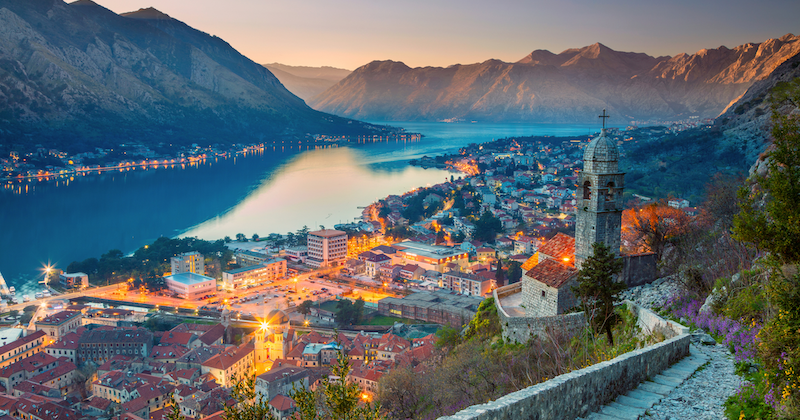
The one-line pitch: A UNESCO-listed medieval walled town on a fjord, ringed by mountains, with Adriatic beaches, and barely a cruise ship day-tripper in sight.
.png?auto=compress&auto=format?auto=compress&auto=format)
Kotor is, objectively, one of the most spectacular settings of any town in Europe. The bay — technically the southernmost fjord in Europe — curves between dramatic limestone mountains that plunge straight into dark blue water. The walled Old Town sits at the water's edge, its medieval Venetian architecture (including the magnificent Cathedral of Saint Tryphon) in extraordinary condition, and its narrow cobblestoned streets filled with the hundreds of cats that have made the city quietly famous among those who know it. Climb to the fortress of St John above the town for views that will genuinely stop you in your tracks.
Montenegro in 2026 is where Dubrovnik was twenty years ago: beautiful, accessible, not yet overrun. easyJet, Jet2 and Ryanair all fly direct to Tivat (about ten minutes from Kotor) from multiple UK airports. The Budva Riviera to the south offers long sandy beaches and a livelier resort scene; the Durmitor National Park inland is a wilderness of canyons, glacial lakes and one of Europe's deepest gorges. Sveti Stefan — a tiny fortified island village connected to the mainland by a causeway — is one of the most photographed images in European travel, and seeing it in person is even better than the pictures.

The one-line pitch: Italy's heel — whitewashed trulli houses, baroque cathedral cities, turquoise Adriatic bays, the country's best olive oil and pasta, and far fewer tourists than anywhere else on the Italian peninsula.

While the Amalfi Coast heaves under the weight of Instagram visitors and Tuscany fills with Americans on wine tours, Puglia — the long, flat heel of Italy's boot — is doing something quietly extraordinary. It's becoming Italy's most exciting food destination (the handmade orecchiette pasta, the burrata from Andria, the olive oil pressed in ancient masserie) while still being dramatically less visited than almost anywhere else on the peninsula.
Lecce is the city that tends to convert sceptics. Called the "Florence of the South" by those who have been, its Baroque architecture is so ornate and golden-hued that it feels like the whole city was carved from a single piece of honeyed stone. The Valle d'Itria, with its extraordinary trulli — conical-roofed stone houses that look like something from a fairy tale — is unlike anything else in Europe. The Adriatic coastline offers clear water, hidden sea caves, and beaches that are beautiful without the "you'll queue for forty minutes for a sunbed" problem of more famous Italian resorts.
Crucially for 2026 bookings: easyJet launched new direct flights from Manchester to Bari (Puglia's main airport) starting in summer 2026. Multiple UK airports have direct routes to Bari and Brindisi.
The one-line pitch: A third of Portugal that most British tourists have never visited — rolling cork forests, medieval hilltop villages, world-class wine, wild Atlantic beaches, and a sky so unpolluted it's UNESCO-certified for stargazing.

Everyone who has ever been to the Alentejo describes it the same way: the feeling that time has slowed down. This vast, sun-drenched region covers nearly a third of mainland Portugal, stretching from the mountains of Marvão in the north to the wild Atlantic coast in the west. Its landscapes — golden plains of wheat, ancient cork oaks, sunflower fields, olive groves — are unlike anything else in Europe in their scale and stillness.
The towns are extraordinary. Évora is a UNESCO World Heritage City with a Roman temple and an eerie, beautiful Chapel of Bones built by Franciscan monks in the 17th century. Monsaraz is a tiny hilltop village — little more than a single cobbled street — perched above the vast Alqueva reservoir, with views at sunset that are genuinely among the finest in Europe. The Alqueva Dark Sky Reserve is the world's first UNESCO-certified starlight tourism destination; on a clear night, the Milky Way is visible to the naked eye in a way that almost no one who has grown up in urban Britain has ever seen.
Where everyone pivoting from Dubai will go: the Algarve. Where they won't: the Alentejo. That gap is the whole point.

The one-line pitch: Three civilisations of extraordinary history on one sun-drenched island, English-speaking, short direct flights, and still dramatically underrated as a destination.
Malta has a peculiar status in British travel: well-known enough that everyone has heard of it, underrated enough that far fewer people have actually been. Those who do go tend to come back slightly evangelical about it, because Malta punches so far above its weight that it surprises almost everyone. Three thousand years of history — Phoenicians, Romans, the Knights of St John, Napoleon, the British — are layered onto an island only 27km long, and the result is a density of monuments, fortifications, cathedrals and archaeological sites that would be the envy of a country ten times the size.
Valletta — the capital and one of the smallest national capitals in the world — is a walled Baroque city of extraordinary grandeur that was named European Capital of Culture in 2018 and has been quietly reinventing itself ever since. Mdina, the old medieval capital, sits on a hilltop and is known as the "Silent City" — its narrow streets within the walls are car-free and feel genuinely timeless. The Blue Lagoon on the island of Comino is one of the most photogenic swimming spots in the Mediterranean. And the Hypogeum of ?al Saflieni — an underground prehistoric necropolis over 5,000 years old, carved entirely by hand — is one of the most extraordinary archaeological sites in the world that almost nobody outside Malta has heard of.
English is an official language. The weather between April and November is exceptional. Direct flights operate from multiple UK airports on Air Malta and other carriers in under three hours. And in a summer when popular Mediterranean resorts are more crowded than usual, Malta remains a destination where you can still find quiet corners that feel like a genuine discovery.
The one-line pitch: Alpine lakes of impossible blue, a fairy-tale capital city, world-class food and wine, and an entire beautiful country small enough to drive across in a morning — all for significantly less than Switzerland next door.
Slovenia is the destination that people who have been there can't stop recommending, and that somehow still never makes it onto mainstream package holiday lists. It ought to be better known: Lake Bled, with its island church and clifftop castle reflected in waters of improbable turquoise, has been photographed millions of times and still looks better in person. Lake Bohinj, just over the ridge, is equally beautiful and has about a tenth of the visitors. Ljubljana, the capital, is a compact, walkable city of Baroque bridges, open-air markets, and a castle that looks out over orange rooftops — think Prague as it was before the stag weekends colonised it.
But what makes Slovenia genuinely special is the combination of things on offer in such a small space. You can ski in the Julian Alps in the morning, swim in a Mediterranean-warm Adriatic bay in the afternoon, and eat dinner in a Michelin-recommended restaurant in a medieval city centre in the evening — all without driving more than two hours. The country is astonishingly well-organised, clean and welcoming. It punches above its weight in food and wine (the Vipava Valley makes excellent whites that are almost unknown outside Slovenia). And crucially, its tourist infrastructure is good enough to make it easy, while its visitor numbers are low enough to make it feel like an undiscovered country.
It would be dishonest to write a guide to alternative destinations without acknowledging that for some families this year — facing higher energy bills, fuel costs, and general economic uncertainty — the most sensible alternative to a Middle East holiday is no overseas flight at all.
The UK staycation market was already strong before the conflict, with the Lake District, Cornwall, the Scottish Highlands and the Peak District all seeing strong advance bookings for spring and summer. And there is a genuine argument, beyond the financial one, for rediscovering Britain in a year when airport uncertainty feels like an unappealing addition to the holiday experience.
The Yorkshire Dales, the Pembrokeshire coast, the North Coast 500 in Scotland, the Jurassic Coast in Dorset — these are destinations that many British families have never properly visited, that require no airport, no travel insurance war exclusion clause, no FCDO advice monitoring, and no queuing at passport control. In a year when the rest of the world feels more complicated than usual, there is something genuinely appealing about that simplicity.
The staycation destinations bucking the overtourism trend this year include Ambleside in the Lake District, Bakewell in the Peak District, and Porthleven in Cornwall — all booking up quickly, but none of them inaccessible. And for groups and families, the UK's large holiday cottage market offers space and flexibility that hotels rarely match.
Here is the decision matrix in plain terms:
| If you want… | Go to… |
|---|---|
| Stunning beaches, very affordable, direct flights, genuinely undiscovered | Albania (Albanian Riviera, Ksamil, Dhërmi) |
| Medieval beauty, dramatic scenery, Adriatic coast, not yet overrun | Montenegro (Kotor, Budva, Durmitor) |
| Authentic Italy, world-class food, baroque cities, beach without the crowds | Puglia (Lecce, Valle d'Itria, Adriatic coast) |
| Peace and quiet, wine country, medieval villages, wild beaches, stargazing | Alentejo (Évora, Monsaraz, Alqueva, Vila Nova de Milfontes) |
| Warm weather, English-speaking, short flights, extraordinary history | Malta (Valletta, Mdina, Gozo, Blue Lagoon) |
| Alpine lakes, brilliant capital city, excellent food and wine, compact and easy | Slovenia (Ljubljana, Lake Bled, Lake Bohinj, Vipava Valley) |
| No flights, no airport uncertainty, simplicity, great British countryside | UK staycation (Lake District, Cornwall, Scottish Highlands, Peak District) |
Every one of these destinations has no FCDO travel advisory, no connection to the Iran conflict, direct or straightforward routes from UK airports, and something genuinely outstanding to offer. None of them will be overwhelmed by the displacement wave this summer in the way that the Balearics, the Greek islands and the Algarve are likely to be.
And all of them will be talked about by the people who go, for months afterwards, as the holiday they didn't expect to be the best one they'd taken in years. That's not reassurance language. That's just what tends to happen when you go somewhere genuinely good that you didn't know well enough beforehand.



The Holiday Extras app gives you instant access to your bookings, updates, and support—anytime, anywhere.

Sign up to our mailing list for more travel advice plus exclusive money-saving offers on your holiday extras!
No need to worry about your data, we take your privacy seriously.

