How to turn 28 days' leave into 61 days.
Don't tell your boss but were here to maximise your annual leave in 2025.

Is plane food really that bad? Here's everything you need to know about dining in the sky, whether you're after budget bites or Michelin-starred meals.
Short on time? Let us summarise this article for you.
In-flight meals have come a long way from simple sandwiches, with airlines offering everything from no-frills snacks to gourmet dishes crafted by celebrity chefs. Your experience varies widely depending on airline, class, and flight length. High altitudes dull taste buds, so meals are specially designed to be flavorful in the air. Budget flyers should bring their own food, while premium passengers can enjoy fine dining. Airlines also cater to special diets with advance notice, and alcohol policies vary by carrier. Whether you're in economy or first class, knowing what to expect can make your journey much tastier.
It's fair to say aeroplane food has a bad rep. But as our taste buds become increasingly more sophisticated – not to mention the fact we're a generation obsessed with sharing everything on social media – the pressure is on airlines to serve up something a little more appetising and Instagram-friendly.
Read on to see what you can expect from your next in-flight meal, if you should skip your plane food or stock up on snacks in an airport lounge.
The first in-flight meal was served in 1919 on the Handley-Page London to Paris route. It was very exotic – a packed lunch consisting of a sandwich and some fruit. Yum.
Hot meals came a bit later. Imperial Airways introduced the first hot in-flight meals in 1927 on their Croydon to Paris route, followed shortly by Air Union offering fancy multi-course trays. Think hors d'oeuvres, crayfish, chicken chausser and Champagne, of course. Things have come a long way since then...
The old saying 'you get what you pay for' generally rings true when it comes to aeroplane food. Don't expect the haute cuisine of yesteryear from Ryanair – the more money you pay, and the longer the flight, the better the food usually is.
The prospect of mass food poisoning on a flight is pretty hair-raising. Fortunately, airline meals are prepared by specialist catering companies with strict guidelines governing the industry.
Depending on who you're flying with, you could expect anything from small snacks in plastic packaging to seven-course gourmet dinners presented on fine china.
There's no need to flag down a flight attendent to order food and drink any more. Many airlines let you pre-order before your flight, and some have intoduced digital ordering platforms that let you order in air from the comfort of your seat.
Flying in cramped cabins at high altitude changes your sense of taste and smell. The dry air and pressure change makes food taste less salty and sweet and blocks and dries out your nose, making your meal less smelly and therefore less tasty.
OK, not quite, but weirdly your ears seem to play a part too. Studies have found that people eating to the backdrop of constant loud noise find food to be less salty and sweet and more crunchy.
Fortunately, airlines these days claim to have developed menus that take into account the peculiarities of dining at 30,000 feet, opting for tomato-based dishes that seem to intensify in taste up in the air.
The meals have to be able to withstand cooking, cooling and reheating and still be tasty and fit for human consumption, so a lot of time and money goes into getting this right.
One thing airlines have done to shake off the image problem of cabin food is get celebrity and Michelin-starred chefs to sort out their menu. Back in 2012, British Airways tasked Heston Blumenthal with creating an in-flight menu for the London Olympics, and more recently Tom Kerridge curated a gourmet range for their short-haul flights.
Short-haul European budget carriers, like easyJet and Ryanair, don't provide any free food or drinks.
If you do purchase from the airline menu during your flight you can pay in sterling or euros, which is good for getting rid of loose holiday change. Prepare to pay up to €3.75 for a cup of tea and €12.50 for a meal deal consisting of a sandwich, water or hot drink and a packet of crisps with Ryanair (from their 2025 menu).
Once you've passed security, stock up on snacks from the restaurants and shops in departures. You could even bring food from home as long as you take note of baggage restrictions. Either way, they're much better value than the in-flight menu.
The good news is that mid-range airlines like TUI provide free meals on their long-haul flights. Some airlines, like Air France and KLM, are scrapping free meals on short and medium-haul flights to cut costs and waste. Make sure to check what's included with your airline.
Airlines like British Airways, Virgin Atlantic and Singapore Airlines usually provide at least one hot meal, snacks and drinks included in the price of your ticket on a long-haul flight. They usually provide free snacks, tea and coffee on short-haul flights too.
The time of your flight will dictate whether you're offered breakfast, lunch or dinner. Note that domestic flights with some US airlines can be particularly light on complimentary food and drink.

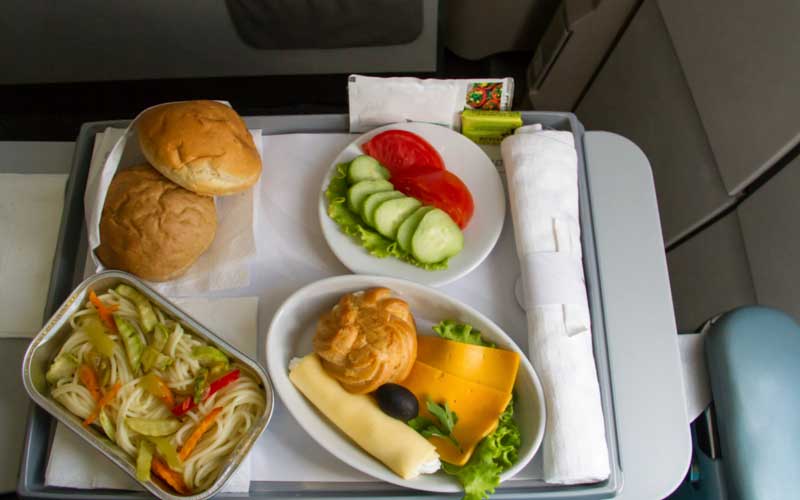
The classic airline meal consists of meat or fish, vegetables or salad, a bread roll and a pudding neatly packaged and positioned on a plastic tray. Today, those in economy seats on longer full-service flights can expect exactly this, with modest complimentary snacks and drinks suited to the time of day and length of flight.
Some airlines do offer the option to upgrade your meal online in advance. For example, with British Airways you'll receive a free standard meal on an economy flight, but you can also order and pay for a more tempting dish from a larger menu from between 30 days and 24 hours before your flight.
Move up to the next level of airline seating, often premium economy, and you're more likely to find menus designed by big name chefs, three-course meals, and drinks included in the cost of your flight with a full-service carrier.
Business seats provide quality seasonal dishes designed by leading chefs with wines to complement the food. You'll sometimes have a choice of lighter cold meals and snacks, as well as full bar service as part of the deal. Cheers!
The first class treatment means indulgent meals and lighter bites designed by top chefs and the complete fine dining experience with bar service included in the ticket price.
First and business class passengers get to use full-size salt and pepper shakers (rather than those silly little sachets), proper crockery, real cutlery and hot towels. Many airlines have returned to metal cutlery in the higher echelons of air travel, after removing it for a time following the September 11 attacks.
The rest of us will have to make do with plastic cutlery, sachets, paper napkins and wet wipes if you're lucky.
Most airlines offer alcoholic drinks on their journeys. Whether you have to pay for them on the likes of Ryanair and easyJet, or they're complimentary with your first-class ticket or offered on your long-haul business flight, many services will keep you topped up.
If you're partial to a mid-air tipple then it's worth noting that the following airlines all operate a strict no-alcohol policy during flights and don't serve any booze:
You're more than welcome to take advantage and stock up in duty free, but it's generally accepted that you can't bring your own alcohol on board and drink it. There are whispers that an airline not offering alcohol may let you drink your own at their discretion if they serve it to you.

Today more than ever, we're conscious about the food we eat, be it for health, religious or personal reasons. Airlines recognise this and most cater for allergies, intolerances, religious beliefs, medical issues, vegetarian and vegan diets and the fussiest of all travellers – children.
Alternative meals usually have to be ordered online before your flight. Check with your airline for their specific offering for passengers with special dietary requirements.
Most airlines serve special meals first – ordering ahead of time will get you fed quicker, which is especially convenient for those travelling with children.
Airline meals for babies are rarely provided so you'll need to pack your own baby food, milk and equipment in your hand luggage, following current baggage guidelines.
Airlines can't sterilise bottles for you. Some may heat up your baby's milk in hot water if necessary but check with your airline before you travel so you can be prepared.
If you're flying on an airline from an Islamic country, the aeroplane food will usually be halal, meaning that it's free from pork and alcohol and made using ritually slaughtered animals.
The same goes for kosher in-flight meals on the Israeli airline El Al.
According to chef and food blogger Dennis Littley, airlines consistently serving up the best in-flight meals across economy and first class include:


The Holiday Extras app gives you instant access to your bookings, updates, and support—anytime, anywhere.

Sign up to our mailing list for more travel advice plus exclusive money-saving offers on your holiday extras!
No need to worry about your data, we take your privacy seriously.

