Explore the full Good Trip Index 2026
See country-by-country rankings and use our interactive tools to explore all eight measures of ethical travel – including LGBT+ safety, sustainability, press freedom and more.
The Good Trip Index doesn't just ask where it's safe. It asks where it's safe – and good across the board.
Short on time? Let us summarise this guide for you.
The Good Trip Index ranks countries across eight measures of ethical travel, including LGBT+ safety, democracy, press freedom and sustainability. The countries that top the list for LGBT+ safety also tend to score highest overall – and the gaps between those two numbers reveal a lot about the destinations many British tourists visit every year.
Pride Month is a celebration. But for many travellers, it also raises a practical question: where in the world can I go and feel safe, welcome and completely free to be myself?
You can look up which countries have the strongest legal protections for LGBT+ people – the Spartacus Gay Travel Index does exactly that, and we use it as one of our eight measures. But legal safety is only part of the picture. A country can score well on LGBT+ rights and still have a weak press, a fragile democracy, a poor sustainability record or a low quality of life.
The Good Trip Index is the only ranking that combines LGBT+ safety with seven other measures. So instead of just asking "where is it safe?", we can ask: where is it safe and a genuinely good trip?
The answer is striking. The countries that protect LGBT+ rights also tend to be the countries that get everything else right.
These are the top 20 countries in the full Good Trip Index that also rank in the global top 30 for LGBTQIA+ safety. The list is sorted by overall GTI rank – not Spartacus rank alone – because that's the more useful question when you're actually planning a holiday.
Every country on this list scores well for LGBTQIA+ safety. But they also score well for press freedom, democracy, sustainability, human freedom, women's rights, animal welfare and quality of life. That combination is what makes a destination not just safe – but genuinely good.
Denmark ranks 1st in the overall Good Trip Index and 15th for LGBT+ safety. That combination – top of the class across every single measure – makes it the best destination in the world for LGBTQIA+ travellers who want the whole package.
Copenhagen Pride is one of Europe's great summer events. But Denmark doesn't top this list because of the parade alone. It tops it because the country delivers on sustainability, press freedom, democracy and quality of life in a way that almost nowhere else does.
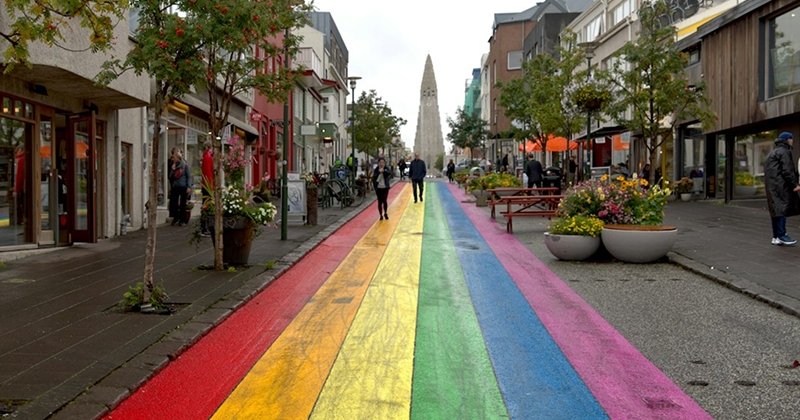
Iceland tops the Spartacus rankings for the fourth year in a row. Same-sex marriage has been legal since 2010, anti-discrimination protections are comprehensive, and Reykjavik Pride is one of the largest per-capita pride events on earth. It also ranks 8th overall in the Good Trip Index.
The midnight sun, the glaciers, the hot springs – Iceland has never needed a hard sell. But for LGBTQIA+ travellers, it offers something rarer than scenery: complete, unreserved safety.
Spain ranks 2nd for LGBTQIA+ safety and 18th overall. Madrid and Barcelona have long been among Europe's great LGBT+ destinations – Chueca in Madrid is one of the most famous gay neighbourhoods in the world, and Sitges near Barcelona has drawn LGBTQIA+ visitors for decades.
But the data reflects something broader than nightlife. Spain's legal protections are among the strongest anywhere, and social attitudes have shifted dramatically since same-sex marriage was legalised back in 2005.
Germany ranks 4th for LGBTQIA+ safety and 9th overall – one of the highest-performing combinations on the whole list. Berlin's status as a world-class queer city is well established, but Cologne, Hamburg and Munich all have thriving scenes of their own.
Germany's anti-discrimination framework is robust, and Christopher Street Day celebrations in Berlin and Cologne are among the largest pride events in Europe.
Portugal ranks 4th for LGBTQIA+ safety and 16th overall. It combines strong legal protections with the relaxed social attitudes that travellers feel the moment they arrive. Lisbon's Príncipe Real neighbourhood is the heart of the city's LGBTQIA+ scene – but the welcome extends well beyond one postcode.
Same-sex marriage has been legal since 2010. Portugal is also one of the most affordable destinations in Western Europe, and for British travellers, one of the easiest to reach.
Malta ranks 2nd for LGBTQIA+ safety and 26th overall. It was the first European country to ban conversion therapy, and its constitutional protections for gender identity and sexual orientation are among the most progressive in the world. Valletta Pride has become a standout Mediterranean event.
A short flight from the UK, English-speaking, packed with extraordinary history – and legal protections that match Northern Europe. Malta punches well above its size.
Toronto and Montreal are world-class destinations for LGBTQIA+ travellers, and Canada's legal protections set the global standard. It's the 14th-best overall trip in the world and one of the four safest for LGBTQIA+ travellers – a combination that's hard to beat.
Same-sex marriage has been legal since 2013, and a culture of genuine openness runs right through the country. New Zealand finishes in the top 10 overall and top 10 for LGBTQIA+ safety. It's a long flight – but a complete package when you get there.
Sydney's Mardi Gras is one of the world's great pride events. Marriage equality became law in 2017, protections are strong across all states, and Australia finishes in the top 15 on both scales. An expensive journey, but a rewarding one.
Taiwan was the first place in Asia to legalise same-sex marriage. It scores strongly across democracy, human freedom and press freedom – a genuinely progressive destination in a region where LGBTQIA+ travellers often have far fewer options.
This chart plots popular British holiday destinations by their LGBTQIA+ safety rank – but shows their overall Good Trip Index rank alongside it. The gap between those two numbers is the story.
Countries near the top – Iceland, Denmark, Norway – score well on both scales. The numbers sit close together. LGBTQIA+ safety is part of a broader picture of strong, ethical governance.
Further down, the gap widens fast. Turkey ranks 69th overall in the Good Trip Index – a mid-table score that reflects its democracy and press freedom indicators – but drops to 152nd for LGBTQIA+ rights. Istanbul Pride has been banned since 2015. The overall score masks a specific, serious problem.
The UAE ranks 79th overall, lifted by quality of life and infrastructure scores, but 208th for LGBTQIA+ safety. Dubai markets itself as a cosmopolitan destination. The legal reality is that same-sex relations are criminalised under federal law. The gap between the marketing and the law is one of the starkest in global tourism.
Malaysia ranks 101st overall – one of the biggest climbers in this year's index – but 195th for LGBTQIA+ rights. Same-sex relations are criminalised under both civil and Sharia law. A country with genuine momentum on sustainability and quality of life, held back by one of the worst LGBTQIA+ records in Southeast Asia.
These gaps are exactly what a single-index ranking can't show you. The Spartacus score tells you where it's safe. The Good Trip Index shows you the whole picture – and sometimes that picture is more complicated than one number suggests.
The green map shows countries that rank in the global top 50 for LGBTQIA+ safety. The red map shows the bottom 30 – and the countries where same-sex relations are criminalised. The pattern is stark: Western Europe, Scandinavia, Australasia and the Americas cluster at the top. Much of the Middle East, North Africa, Central Asia and sub-Saharan Africa sits at the bottom.
Jamaica (LGBTQIA+ #152, GTI #113) is one of the Caribbean's most popular UK destinations. But same-sex intimacy remains a criminal offence, and social attitudes can be hostile – particularly outside resort areas.
Morocco (LGBTQIA+ #183, GTI #138) is a four-hour flight from the UK and one of the great travel destinations on earth. Article 489 of the penal code criminalises same-sex relations with up to three years' imprisonment.
Egypt (LGBTQIA+ #195, GTI #137) has no specific anti-homosexuality law – but "debauchery" provisions are routinely used to prosecute LGBT+ people. There have been high-profile cases of entrapment using dating apps.
The UAE (LGBTQIA+ #208, GTI #79) represents the most extreme gap on our chart. It scores well enough overall to sit in the top half of the index, while maintaining laws that criminalise same-sex relations with penalties including imprisonment.
The bottom of the LGBTQIA+ rankings includes countries where same-sex relations can carry the death penalty: Yemen (216th), Iran (215th), Saudi Arabia (212th), Afghanistan (212th) and Somalia (211th). These are not tourist destinations in the conventional sense – but some, particularly Saudi Arabia which is actively pursuing a tourism strategy, may appear on travellers' radars. The data is clear.
Anyone can look up which countries are safest for LGBTQIA+ travellers – the Spartacus Gay Travel Index is publicly available and we'd encourage every traveller to consult it. What only the Good Trip Index can tell you is where that safety sits alongside everything else.
Is the country democratic? Is the press free? Is it sustainable? Are women safe? Is quality of life high? Those questions matter – not just ethically, but practically. They shape the kind of country you'll actually experience when you arrive.
The answer, overwhelmingly, is that the countries that protect LGBTQIA+ rights also protect everything else. The top of our list isn't a coincidence – it's a pattern. Countries with strong institutions, a free press, high quality of life and a functioning democracy are the same countries that extend full legal protections to LGBT+ citizens and visitors.
For Pride Month 2026, that's the message: go where it's good. Not just good for one thing – good across the board.
Rankings are taken from Holiday Extras' Good Trip Index 2026, which scores 183 countries across eight measures of ethical travel: sustainability, LGBT+ safety, press freedom, democracy, animal welfare, women's safety, local quality of life and human freedom.

The Holiday Extras app gives you instant access to your bookings, updates, and support—anytime, anywhere.

Sign up to our mailing list for more travel advice plus exclusive money-saving offers on your holiday extras!
No need to worry about your data, we take your privacy seriously.

